
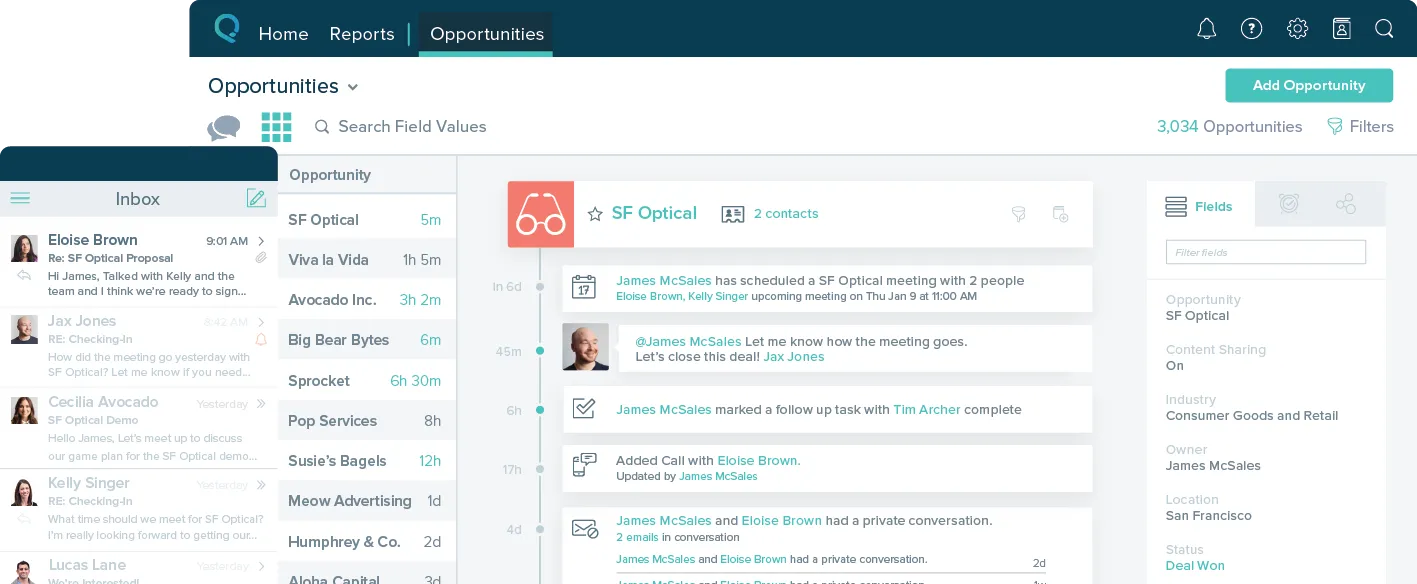
2026 Update: SalesforceIQ (formerly RelateIQ) was officially discontinued by Salesforce several years ago, and Salesforce Essentials has since been folded into Salesforce Starter. If you're still looking for an affordable, flexible CRM to replace SalesforceIQ, the alternatives below have all been updated with current pricing and features.
After the announcement made by Salesforce.com that SalesforceIQ wouldn't support GDPR, it became clear that they would discontinue the product they acquired as RelateIQ. In its early days, SalesforceIQ introduced probably the most flexible approach to CRM. The fundamental idea was that every CRM object could be presented as an adjustable table with hard-linked relation to a Contact or Company. It was a simple yet effective solution for small to medium Sales and Marketing teams. Setting up a new entity was easy compared to Sales Cloud or similar solutions -- much like adding new columns to MS Excel and adjusting cell format.
Now that Salesforce.com has fully discontinued the product (and its successor Salesforce Essentials has been rebranded to Salesforce Starter), many former SalesforceIQ users face rising costs if they stay inside the Salesforce ecosystem. The key major feature of SalesforceIQ/RelateIQ was its open APIs. To get full advantage of Salesforce Sales Cloud API you still need an expensive plan -- and for a team of five, the annual cost adds up quickly. For 2-4 person Marketing/Sales teams, I recommend considering other SalesforceIQ alternatives that are cheaper yet provide similar features.
5 SalesforceIQ Alternatives
HubSpot Free CRM
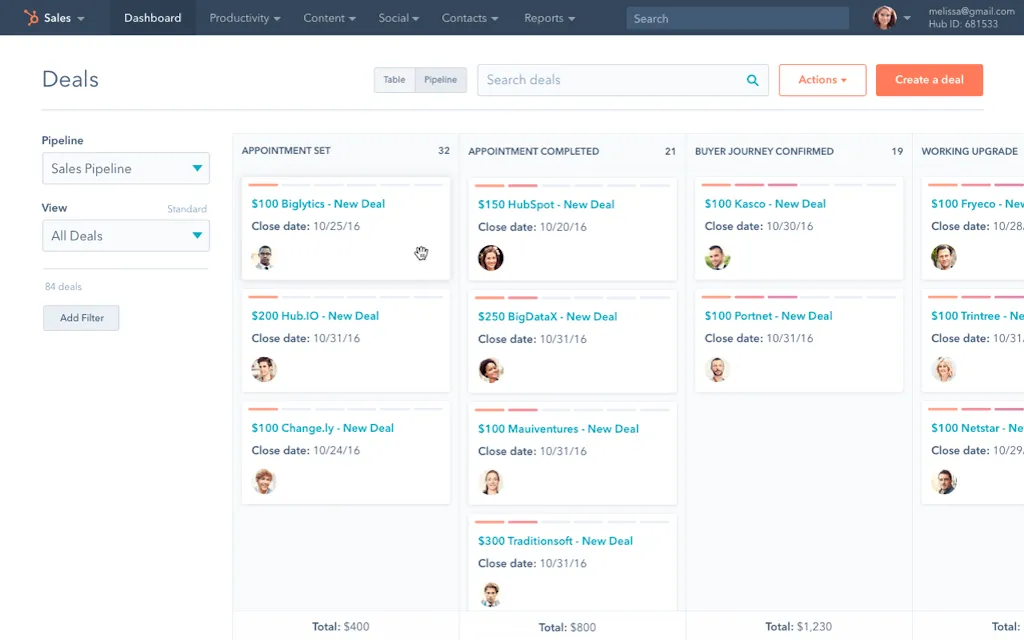
HubSpot CRM remains free and is the most popular SalesforceIQ replacement based on market data. It has all the features needed by small to medium sales teams -- and its free tier has expanded significantly over the years.
With integration with Gmail and Outlook, HubSpot CRM is similar to what SalesforceIQ offered: you can see the full history of customer communication and notes inside each contact card. Tracking emails and dashboards are superior to what SalesforceIQ ever provided. Deal pipelines (formerly called Opportunities) bring your sales productivity to the next level.
HubSpot has also added Breeze AI features across the platform, including AI-powered email writing, predictive lead scoring, and content generation tools. These AI capabilities are available even on lower tiers, making HubSpot one of the most feature-rich CRMs at any price point.
The free tier supports unlimited users and up to 1,000,000 contacts. You also get forms, live chat, and basic reporting at no cost. If you need more, current pricing is:
- Free CRM -- $0 (contact management, deals, tasks, email tracking)
- Starter -- $20/month/seat (removes branding, adds automation)
- Professional -- $100/month/seat (advanced automation, reporting, sequences)
For those who used SalesforceIQ primarily for its Gmail integration, HubSpot offers the same features: send emails from the CRM, track opens and clicks, use snippets and templates, and log everything automatically.
Moving off SalesforceIQ or Salesforce? Our HubSpot migration service moves contacts, deals, and history with zero data loss. Start with a free audit.
Kommo (formerly AmoCRM)

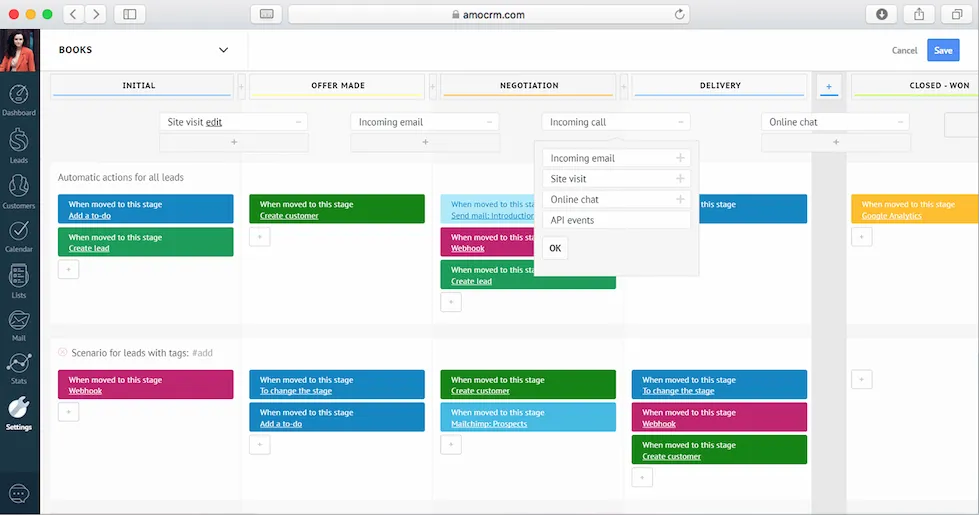
You may not have heard of Kommo by its current name -- it was known as AmoCRM until it rebranded in 2022. Kommo has evolved into a messaging-first CRM, heavily focused on conversations through WhatsApp, Instagram DM, Telegram, and Facebook Messenger.
It remains a user-friendly solution with excellent design, integrates with all major email providers (including Gmail and Office 365), and has open APIs as well as Zapier integration. The messaging-based approach makes Kommo a strong fit for sales teams that do most of their communication through chat apps rather than email. If your team sells via WhatsApp or social DMs, Kommo is worth a close look.
Pipedrive
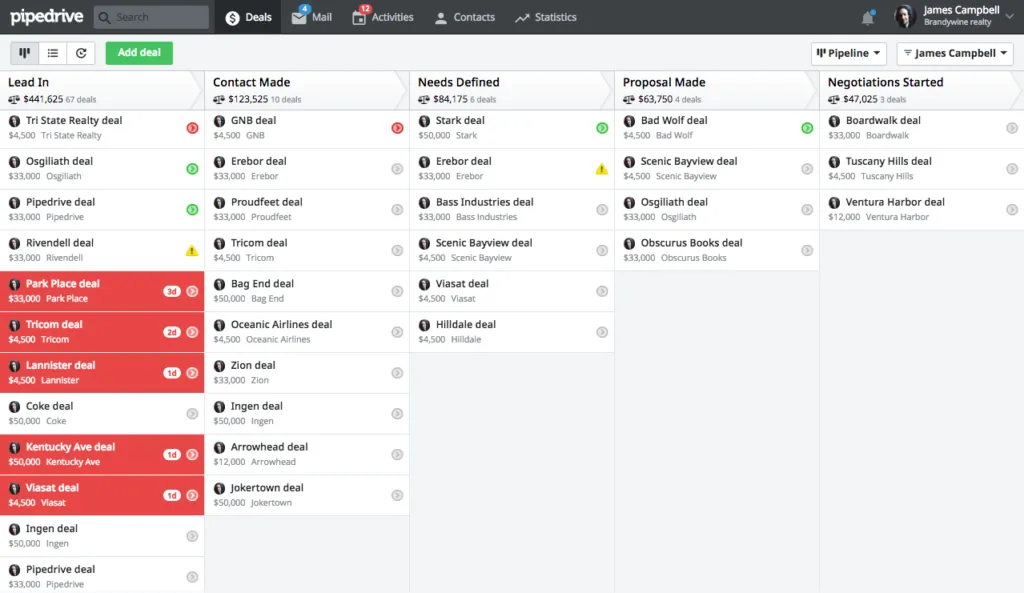
Pipedrive remains the best pure sales pipeline management tool on this list. It is inexpensive compared to Salesforce, easy to use, and has a solid API. Its signature Kanban pipeline view -- once a key differentiator -- is now standard across CRMs, but Pipedrive still executes it better than most.
Pipedrive has added an AI Sales Assistant that analyzes your pipeline data, suggests next actions, and helps prioritize deals. It also has excellent integration with major email services, Google Calendar, and Google Contacts.
Current pricing starts at $14/month/seat on the Essential plan, making it one of the most affordable dedicated sales CRMs. Advanced and Professional tiers add workflow automation, email sequences, and revenue forecasting. Pipedrive remains excellent for teams that want a focused sales tool without the complexity of a full marketing platform.
Airtable
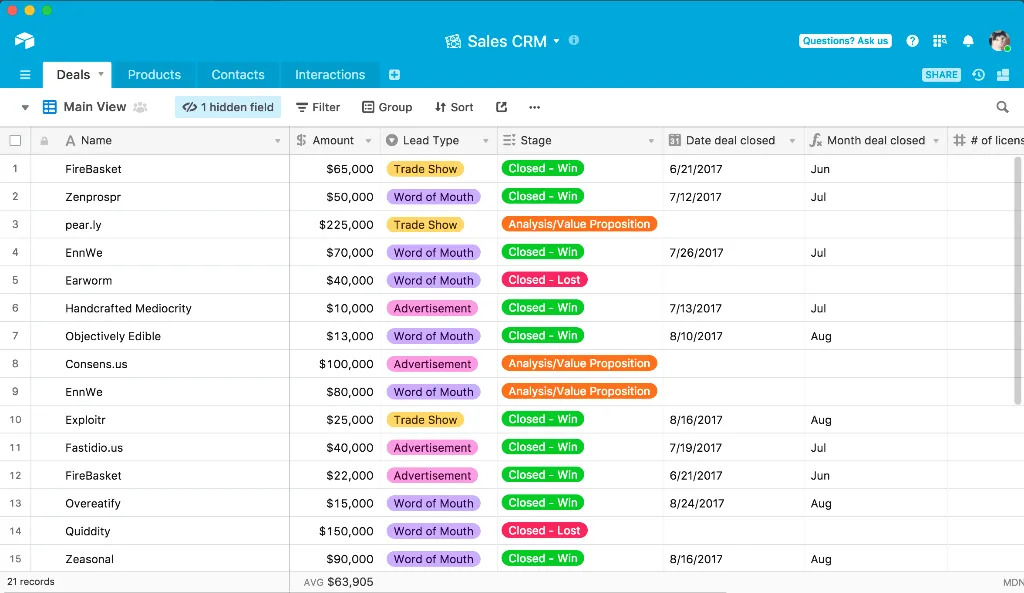
Airtable has evolved significantly since it first appeared as a SalesforceIQ alternative. While still not a traditional CRM, it remains the closest alternative to SalesforceIQ when it comes to flexibility and custom entities/relationship management.
One of the major differentiators of SalesforceIQ/RelateIQ was its flexible tables that you could set up for any kind of client-relation operations -- pending payments, customer orders, PR lists, webinar attendees, and more. Airtable gives you all of that flexibility and then some.
What's new: Airtable now offers Interface Designer, which lets you build custom CRM interfaces on top of your data -- complete with forms, dashboards, and record detail views. Many teams now use Airtable as a lightweight CRM with built-in automations (sending emails, updating records, triggering Slack notifications) that rival what dedicated CRM tools offer.
Current pricing: the free tier covers up to 1,000 records per base with basic features, and paid plans start around $20/seat/month -- check Airtable's pricing page for current tier names and limits, since they change often.
The trade-off remains the same: Airtable does not natively support CRM features like email activity tracking, pipeline reporting, or call logging. But if you loved SalesforceIQ for its flexible tables, Airtable is the spiritual successor.
Salesforce Starter (formerly Sales Cloud Essentials)
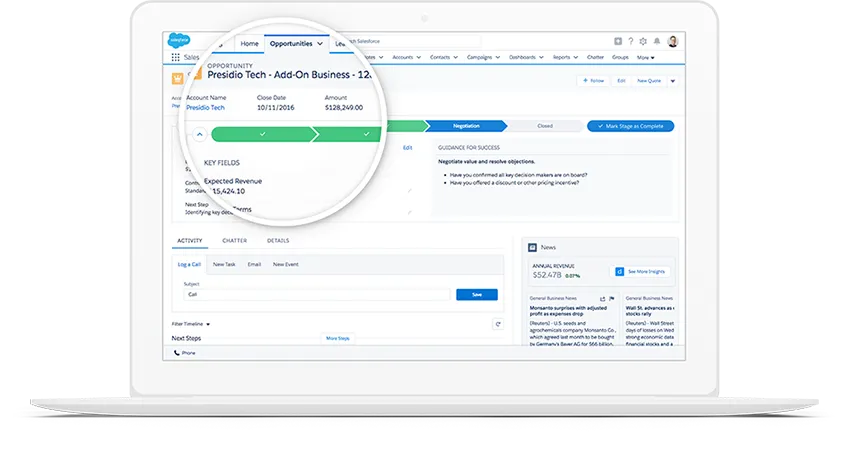
Salesforce has reorganized its small business offerings. What was once called Salesforce Essentials is now Salesforce Starter at $25/user/month, with a Pro Suite tier at $100/user/month for teams that need more automation and customization.
Being the leading CRM, Salesforce offers an excellent platform to manage sales teams of any size. The Lightning interface looks modern and the ecosystem of AppExchange integrations is unmatched. Salesforce has also introduced Agentforce AI features -- AI-powered agents that can handle tasks like lead qualification, email follow-up, and data entry.
That said, Salesforce remains the most complex option on this list. It is harder to learn and not as easy to use as HubSpot, Kommo, or Pipedrive. The primary complaint of Salesforce users is still price -- and SalesforceIQ's unique flexible table approach and open APIs were not carried over to Starter. For small teams, the cost and complexity may outweigh the benefits unless you specifically need the broader Salesforce ecosystem. For a full feature-by-feature breakdown, see our HubSpot vs Salesforce comparison.
Conclusion
In 2026, the landscape for former SalesforceIQ users is clearer than ever:
HubSpot Free CRM is the winner for most SalesforceIQ refugees. It gives you contact management, deal tracking, email integration, reporting, and now AI features -- all at no cost. Add the free Marketing tools for forms, live chat, and email. It is the most complete replacement with the lowest barrier to entry.
Pipedrive is the best pure sales tool if your team lives and breathes pipeline management. At $14/month/seat, it is focused, fast, and does one thing extremely well.
Airtable is for those who loved SalesforceIQ's flexibility. If custom tables, relationships, and a spreadsheet-like interface were what made SalesforceIQ special to you, Airtable (especially with Interface Designer) is the closest spiritual successor.
Kommo is a strong pick if your sales conversations happen primarily through messaging apps like WhatsApp and Instagram.
Salesforce Starter makes sense only if you need the broader Salesforce ecosystem -- AppExchange apps, enterprise integrations, and advanced automation. For most small teams, it is overkill.
Whichever you choose, take a trial and talk to a professional agency before you make your final decision.
Thinking about switching CRMs? Our HubSpot migration services make it easy to move from any CRM to HubSpot with zero data loss -- if you're coming from Salesforce specifically, see our Salesforce to HubSpot migration page. Or start with a free HubSpot audit: written findings, reply within one business day, no commitment.