
B2B Marketing for Software and Tech Companies
B2B marketing for software and tech companies is shaped by long sales cycles, large buying committees, and small target markets - so choosing the right channel for each stage of the journey matters more than raw budget. LinkedIn, Google Ads, and Capterra are the proven core, with cost per lead typically running $10 to $250. This guide walks through the full channel mix, campaign budgets, and analyst relations that move pipeline for software companies.
B2B Software and Tech Growth Challenges
- Software companies need to have a strategy for keeping up with larger and newer competitors
- Software and technology companies have long sales cycles and need to build authentic relationships that convert into sales opportunities
- Tech companies must deeply understand their clients and their needs in order to stay relevant
- New competitors with new proprietary technology are a constant challenge
- Many B2B Software and Tech companies struggle to allocate resources to marketing projects
Long Sales Cycles and Limited Target Market
Software companies need to be especially mindful of the long sales cycles and high lifetime value typically associated with B2B marketing.
Industry surveys have found that most businesses take more than three months to complete a software purchase, with around 35% citing three to six months and 27% taking six to nine months. The extended process is attributed to multiple stakeholders in the buying process, buyers preferring self-guided search over sales meetups, and difficulty in reaching consensus among decision makers who have very different and often conflicting views of the purchase. Software/Tech providers can make it easier to navigate the purchase process by providing potential buyers with helpful information, tools, and demos, which can simplify decision-making and foster consensus.
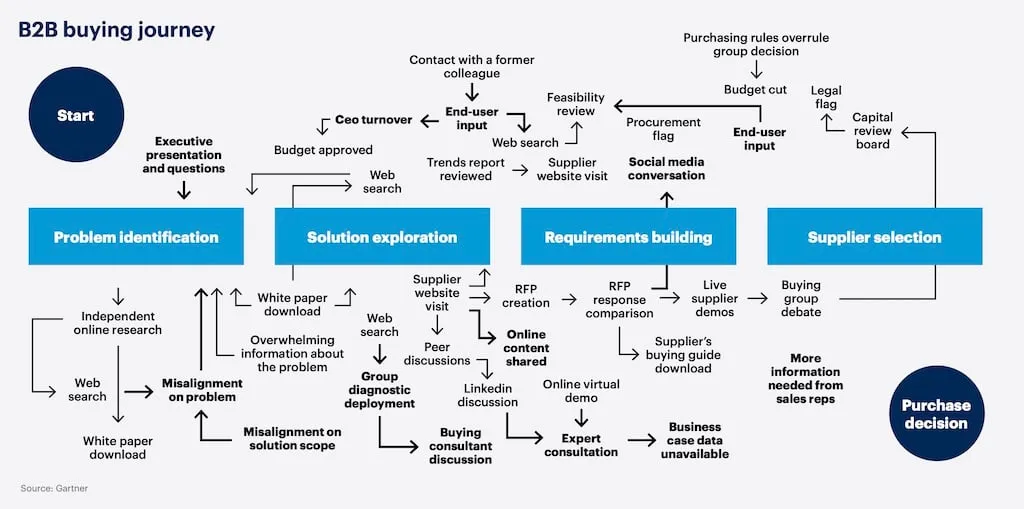
To maximize their chances of success, companies should build comprehensive marketing campaigns that use multiple channels across the entire buyer's journey. Search ads, display ads, content marketing and outbound email campaigns can be used to draw initial interest and create awareness. After the initial contact, companies should focus on providing helpful resources, such as white papers, e-books, and case studies, to establish thought leadership and credibility. Finally, personal outreach through sales calls or meetings can help close the deal.
B2B software investments are typically a collaborative effort between multiple influencers and decision-makers. The size of these buying groups has been increasing, with up to nine people involved in purchasing software at their organization. Additionally, non-IT staff have become involved in tech needs, further complicating the process. Reconciling disparate information and building consensus can take up to 15% of the buying cycle. Software providers need to provide targeted information to make the purchase process easier for specific buyer personas.
Read our Guide to B2B Customer Lifecycle Marketing.
Limited Target Market
Many B2B markets may have a small number of participants. To reach them, companies should focus on using channels like LinkedIn or industry-specific forums to target a specific audience. Ultimately, software companies need to develop a comprehensive marketing strategy that takes all these factors into consideration to achieve success.
Complexity of Product
Software and tech B2B companies often have complex products that require explanation to potential customers. This can be difficult to do in a short amount of time or with limited resources, as customers need to understand how the product works before investing in it.
Customer Journey
Tech companies should be aware of the customer journey and baseline customer profile in order to effectively address their customer's needs. The customer profile should include an understanding of the customer's technical skills, expectations, motivations and how they analyze information in making a purchase decision.
In his 1966 book Breakthrough Advertising, copywriter Eugene Schwartz described five stages of awareness a customer moves through before making a purchase - a model that later shaped the modern customer journey concept:
- Unaware: the customer is not aware of the problem your product or service solves.
- Problem Aware: customer is aware of the problem, but doesn't know how to solve it.
- Solution Aware: the customer knows what kind of result they want, but doesn't know that your product can help.
- Product (Provider) Aware: the customer knows what you're selling, but not yet sure if your product is right for them.
- Most Aware: the customer knows about your product and is only interested in terms, details, and price.
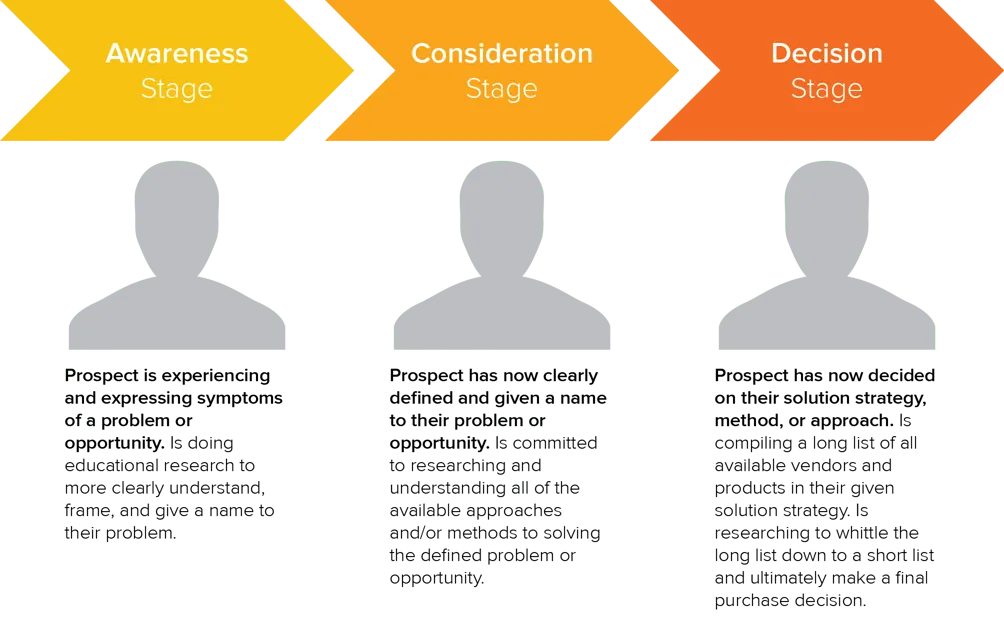
When launching a new marketing campaign or creating marketing materials, you should always understand what stage of the buyer's journey you are targeting.
Content ideas for every stage of the customer journey
Top of the Funnel (Awareness):
- Ebooks on current industry trends
- Case studies highlighting success stories
- Whitepapers focusing on topics relevant to the target audience
- Infographics summarizing data-driven insights
- Blog posts introducing key concepts
- Videos illustrating the benefits of the product
Middle of the Funnel (Consideration):
- Product comparison blog posts
- A webinar on a specific use case
- Email series introducing key features
- Podcasts featuring industry experts
- Detailed product videos
- Checklists for making the right purchase decision
Bottom of the Funnel (Decision):
- Product reviews
- Free trials or demos
- Coupons for discounts
- Testimonials from customers
- FAQs to help customers make the final choice
- Live Q&As with sales reps
Competitor Analysis
Competitor analysis is a critical component of successful marketing for startups and businesses entering new markets. Knowing what channels your competitors are using to generate traffic and convert leads can help you quickly identify which marketing channels are working and which should be avoided, saving you time and money.
Researching your competitors can be done in a variety of ways. Examining their websites and social media accounts to determine what topics and content they are using to target customers, as well as studying the keywords they are targeting with SEO, are important steps in understanding how your competitors are marketing themselves.
How to run competitor analysis?
- Analyze the website: how leads are captured (forms, free demos, webinars, downloadable materials, free trials, discounts), is there a chat on the site, what content they use (blog), what their messaging looks like (headlines, CTAs)
- Look for press releases and news about awards, mentions in analyst reports (Gartner, Forrester, etc.) or other third-party sources, look for news about participation in trade shows/conferences
- Check social networks: look how actively social networks are used (usually the site has links to Twitter, Facebook, LinkedIn, Instagram)
- Facebook Ads Library: look for advertisements placed by a competitor (enter the exact name of their Facebook page)
- LinkedIn Ads: find the company's page and click Ads in the left column to see what kind of ads your competitor runs
- SEO tools: use services like Ahrefs or SEMrush to analyze search positions, traffic sources, links, and contextual advertising
In advertising, pay attention to the offer and topic: the product, free trial, lead magnets, webinars, etc.
Digital Channels for B2B Software/Tech Companies
While traditional platforms such as LinkedIn, Facebook, and Google Ads remain popular, companies should also explore other channels including Capterra, Quora, Reddit, Xing, vertical rankings, listings, reviews, analyst reports, influencers, and marketplaces. Content marketing is an essential tool for connecting with customers at different stages of the sales process.
Online channels:
- Paid search: Google Ads, Bing, etc.
- SEO
- Organic and Paid Social: LinkedIn, Facebook, Twitter
- YouTube (part of Google Ads)
- Quora, Reddit
- Regional platforms: Xing (Germany), Coc Coc (Vietnam), WeChat, Baidu, Yandex
- Capterra, vertical rankings, listings, reviews, analyst reports (Gartner, Forrester)
- Influencers (blogs, social networks, podcasts)
- Marketplaces (Salesforce AppExchange, Shopify App Store, etc.)
Which Platforms Work Best for B2B Advertising?
Traditionally, B2B companies should start testing with the four biggest paid search platforms:
- LinkedIn Ads (see the pros and cons for B2B)
- Facebook Ads
- Google Ads
- Bing Ads
Additionally, there are specialized advertising platforms that work great for tech companies:
- Capterra (Gartner Digital Markets Network that also includes GetApp and Software Advice) for product-based IT companies
- Quora (similar to paid search but allows targeting people interested in specific questions or topics)
- Reddit (works great if there's a subreddit for your market/niche or customer segment)
Regional platforms:
- Xing — a LinkedIn analog, popular in Germany, Austria, and Switzerland
- Coc Coc — Vietnamese search engine and ad platform
- Baidu — the largest Chinese search engine
Ideas for paid search campaigns
In addition to direct queries, such as "CRM for call center" or "Core banking software", you can also target:
- Competitor names (as keywords, not in the ads themselves)
- Related products
- Trade shows and events that your target audience can attend
- Other queries that customers may search for during the early stages of their journey
How Much Do B2B Paid Campaigns Cost?
The average ad spend for B2B tech companies per month varies significantly depending on the size of the business, product type, target audience, and other factors. Generally, most B2B tech companies will spend between $1,500 and $7,500 per month on advertising.
Average cost per lead for digital channels varies from $10/lead to $250/lead, getting to $500/lead for the most extreme industries (when targeting key decision makers in competitive markets like banking technology).
By industry benchmarks, the average cost-per-click (CPC) in the software industry is around $3.80, and the most expensive software keyword CPC can reach $95.
Read our complete guide on B2B Lead Generation with LinkedIn Ads.
Analyst Relations (Gartner, Forrester...)
By widely cited industry estimates, analysts influence roughly 80% of corporate IT solution purchases. This holds across a variety of industries and areas, such as CRM, eCommerce, banking and ERP systems. Companies rely on the data compiled and the opinions expressed by analysts, as it is often the only unbiased source of supplier information available to them.
Being mentioned in an analyst report can significantly boost a company's brand recognition, credibility, and quoteability. Additionally, analysts often advise the largest companies and governmental organizations, which could be potential end customers for B2B tech companies. Being included in analyst reports is often a requirement for many international tenders and vendor selection processes.
The analytics agencies in this field are Gartner, Forrester, IDC, Celent, Ovum and others. They all provide consulting services to their clients, and some organizations only allow businesses featured in certain reports to tender quotes, such as those in Gartner's Magic Quadrant.
Key Analyst Reports for B2B Tech Industry
Gartner:
- Magic Quadrants
- MarketScope
- Competitive Landscape
- Critical Capabilities
- Cool Vendors
- Hype Cycle
Forrester:
- Wave Reports
- Now Tech Reports
- Market Overviews
- TechRadar Reports
- Vendor Landscape Reports
For any B2B tech company, the goal should be to ensure that the experts responsible for their market specialism are aware of their products, their benefits and any success stories. This involves informing the analysts and encouraging them to include the company's solutions in their reports.
To work with analysts, a company should first research the relevant materials and determine the most effective way to present their products. They must then sign up for a vendor briefing associated with the particular analyst. Vendor briefings are free events and do not require a subscription to the reports.
Outbound Campaigns
When it comes to B2B tech companies, outbound marketing is often an essential strategy for finding leads and developing relationships. Outbound campaigns typically entail cold calling and emailing prospects with the goal of turning them into paying customers.
One of the most common reasons why outbound campaigns may not work is due to the use of an irrelevant subject line. Prospects will simply ignore cold emails if the subject line does not pique their interest. Similarly, failure to personalize messages can be a major impediment to success. Cold calls or emails that are clearly generic will most likely fail.
On the other hand, outbound campaigns can be effective in certain situations:
- "Hype" topics: If the email centers around a newsworthy topic that is timely and current, it can capture the prospect's attention
- "Warmed" audience: Prospects who have already heard about the company are far more receptive
- Personalized messaging: A prepared, tailored message addressing the prospect's specific needs makes all the difference
An effective outbound campaign requires more than a one-size-fits-all approach. Start by gathering contact info for each target and researching them on LinkedIn, Twitter, or Google to get a better idea of their company and projects. Craft a series of three to five emails that start by acknowledging the recipient.
Instead of "Hi my name is...", try:
- "Our mutual connection, [Name], told me about your work..."
- "Saw that we both have a passion for [Topic], and I wanted to connect..."
- "I loved your post on [Topic], and wanted to see if you'd be interested in talking more about it."
- "I noticed you..."
Offline Channels and PR
Offline Channels for B2B Software/Tech Companies:
- Exhibitions and conferences
- Analysts and consultants
- Local Partners/Agents/Introducers
- Global Partners
- Professional Associations
- Outbound/Cold calling
Traditional PR: For medium and small sized companies, traditional PR activities are almost completely replaced by digital tools today. A mention in an analyst's report can yield better business results than a hundred press releases and mentions in traditional media.
Trade shows/Conferences/Offline Events
Tips to help you find the right trade shows and conferences:
- Check competitor websites. Many companies list the events they're attending, so you can easily see which ones are worth attending.
- Ask your customers. They know which events are popular in their industry and which ones are worth attending.
- Use event recommendation engines. Services like Eventbrite can help you find relevant events.
- Check trade publications. Many trade publications list upcoming events and conferences.
- Use social media. Search Twitter and LinkedIn for industry-relevant hashtags and join industry-related groups.
The main KPI for events should be the number of leads and number of meetings. Owning an event can cost from $1,000 to participation in a decent exhibition with a booth costing between $5,000 and $15,000. Top exhibitions can cost between $30,000 and $60,000, sometimes higher.
Use digital ads for your offline activities
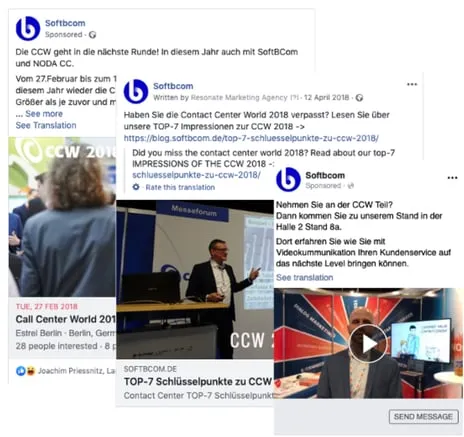
For the best outcomes, use your online channels (Facebook and LinkedIn) for advertising. Location-specific Facebook ads can be an effective tool for large conventions.
- Before the event: create events on social networks, advertise them, contact everyone who is interested and make appointments at the show
- During the event: in the first hours, make a video right at the event and advertise it using geolocation targeting
- After the event: write a "7 takeaways" article about the event and promote it through social networks
Put This Into Practice
Marketing for a software company is a channel-mix problem: pick the right channels for each stage of a long buying cycle, then measure what actually converts. Getting that mix right - and proving it in the numbers - is the work we do every day for B2B software and tech clients.
Want a second pair of eyes on your channel mix and reporting? Our marketing analytics and HubSpot consulting services turn the tactics in this guide into a measurable pipeline. Still deciding on tooling? Compare your options in HubSpot vs Salesforce.
Not ready to commit? Start with a free HubSpot audit - written findings on your current setup, delivered within one business day, no commitment.